
Introduction
Table of Contents
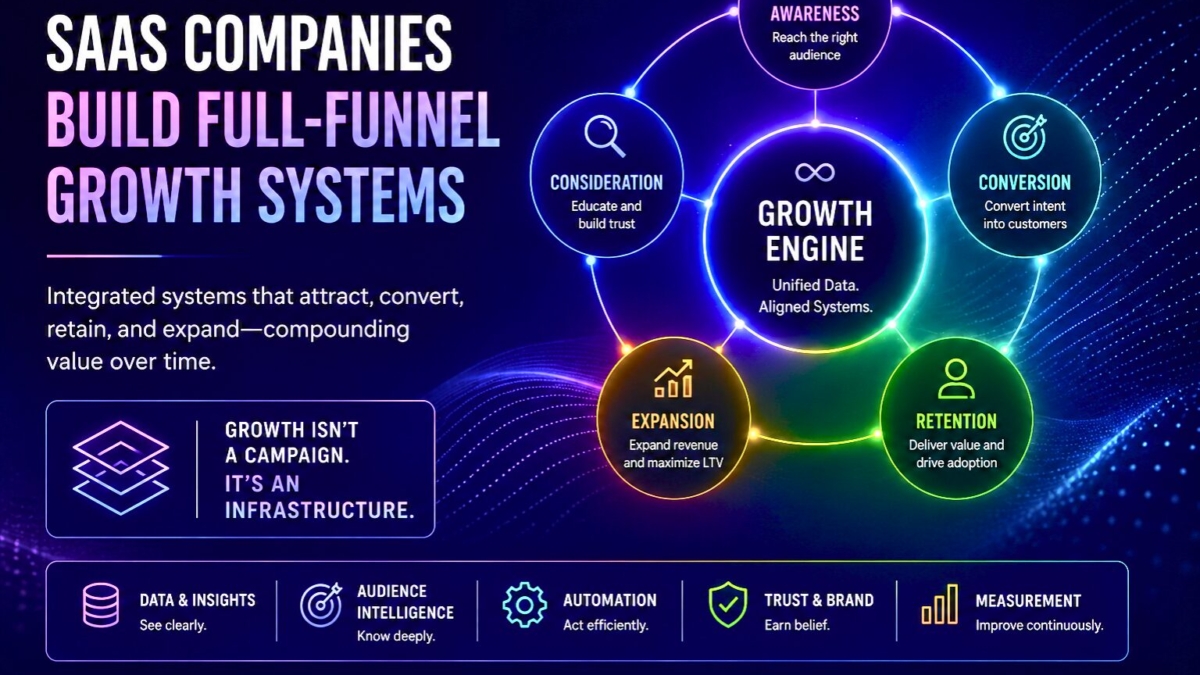
Modern SaaS growth systems are no longer built around isolated campaigns. Most SaaS companies do not have a traffic problem. They have a systems design problem.
The internet is full of companies generating impressions, clicks, leads, webinar registrations, demo requests, and short-term spikes in pipeline activity. Yet many of those same companies quietly struggle with rising acquisition costs, inconsistent conversion quality, weak retention economics, and increasingly fragile growth.
The problem is rarely the ad platform itself. It is usually the architecture behind the acquisition system.
Modern SaaS growth systems are increasingly designed around integrated acquisition infrastructure rather than isolated campaigns.
This is where modern SaaS growth has fundamentally changed.
Performance marketing used to be heavily associated with channel optimization:
- better targeting
- lower CPCs
- improved creatives
- conversion rate testing
- attribution models
Those mechanics still matter.
But sophisticated SaaS operators increasingly understand that scalable growth is not created by isolated campaign performance.
It is created by:
- trust infrastructure
- audience intent alignment
- demand generation systems
- messaging continuity
- funnel coherence
- retention economics
- distribution compounding
- acquisition sequencing
In other words:
Modern performance marketing is no longer primarily an advertising problem. It is an acquisition systems design problem. The companies that scale efficiently today are rarely the ones running the loudest campaigns.
They are usually the ones that:
- understand buyer psychology deeply
- orchestrate trust across the entire customer journey
- integrate content and distribution intelligently
- align marketing with revenue operations
- compound authority over time
- reduce friction at every stage of intent
This is what full-funnel growth systems actually look like in practice.
Performance Marketing Stops Scaling When Funnels Are Treated Like Campaigns
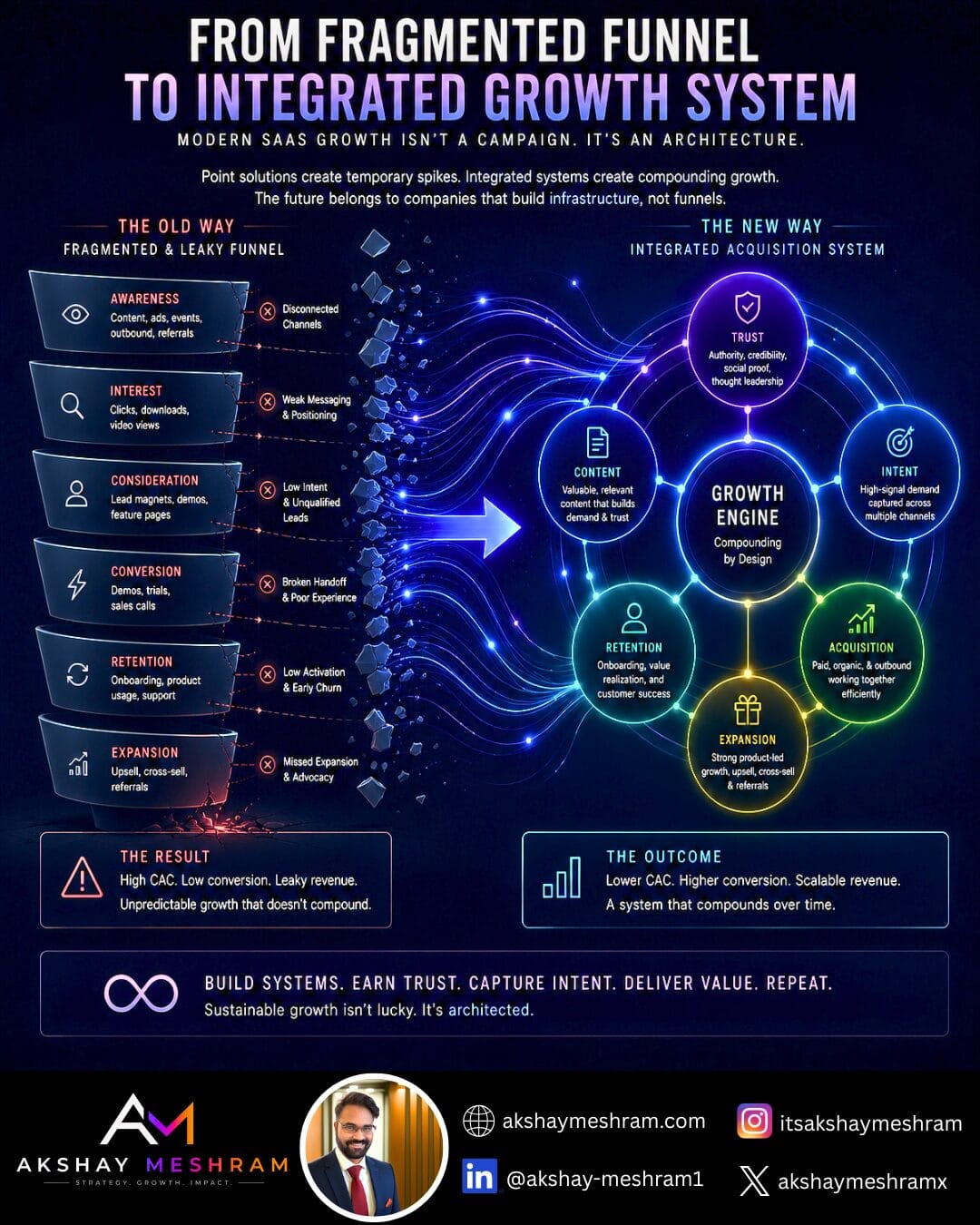
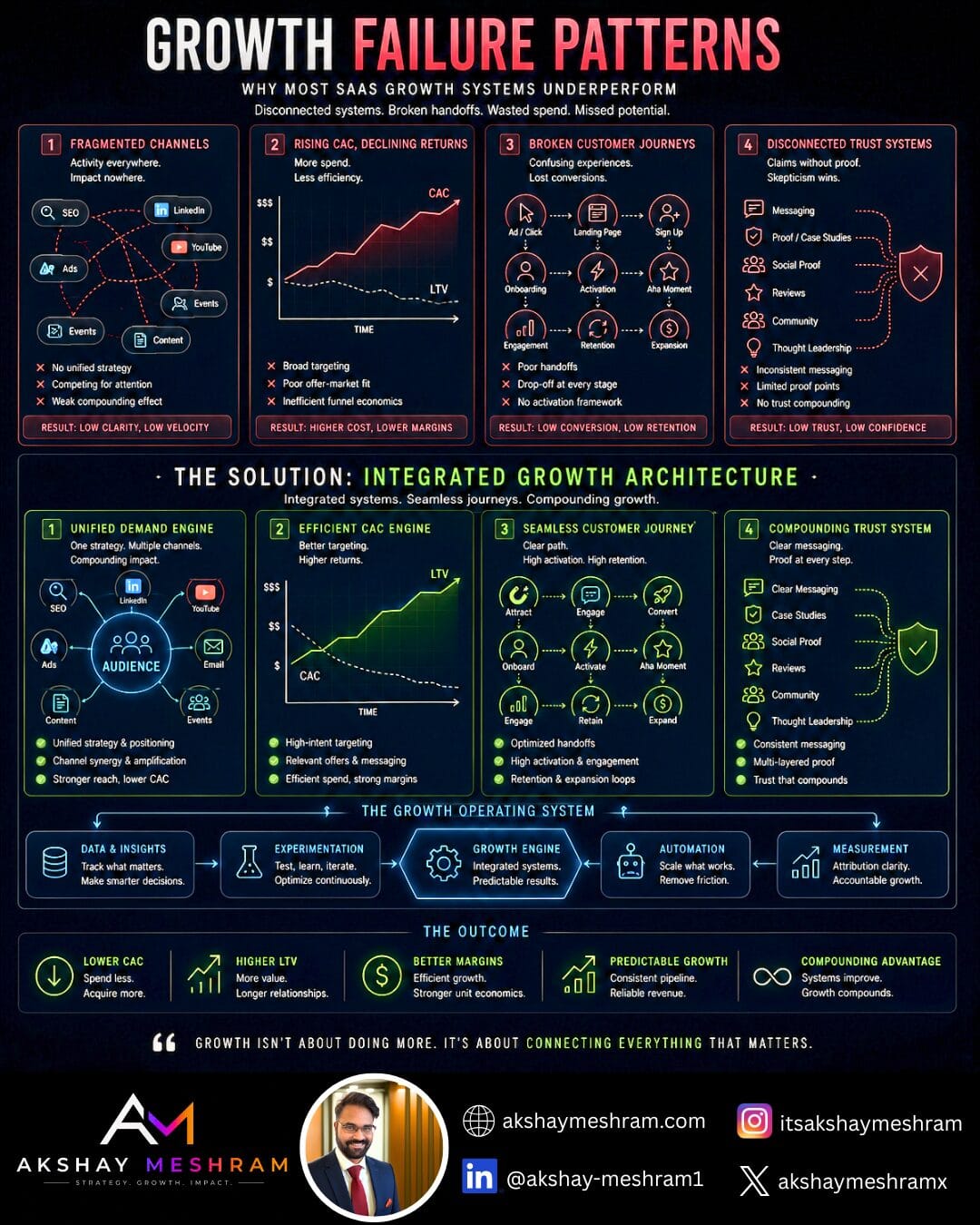
The majority of SaaS acquisition systems are operationally disconnected.
Not intentionally.
Structurally.
Awareness campaigns operate separately from lifecycle messaging.
Paid acquisition teams optimize for lead volume while sales teams optimize for qualification.
SEO teams chase traffic while revenue teams chase pipeline.
Retention systems are treated as customer success responsibilities instead of growth multipliers.
Everything becomes fragmented.
As a result, the company experiences a familiar pattern:
- customer acquisition costs increase
- conversion quality declines
- attribution becomes less reliable
- scaling paid spend becomes harder
- growth efficiency deteriorates
Most companies respond by trying to optimize channels harder.
Sophisticated operators step back and question the system itself.
That distinction matters.
Because performance marketing eventually stops scaling when:
- the market no longer trusts the brand sufficiently
- messaging continuity breaks across funnel stages
- acquisition channels operate independently
- demand capture outpaces demand creation
- conversion friction accumulates silently
This is why many high-growth SaaS companies eventually reach a plateau where increasing spend produces weaker incremental returns.
The issue is often not targeting.
It is architectural incoherence.
The Real Problem: Most SaaS Funnels Are Operationally Disconnected
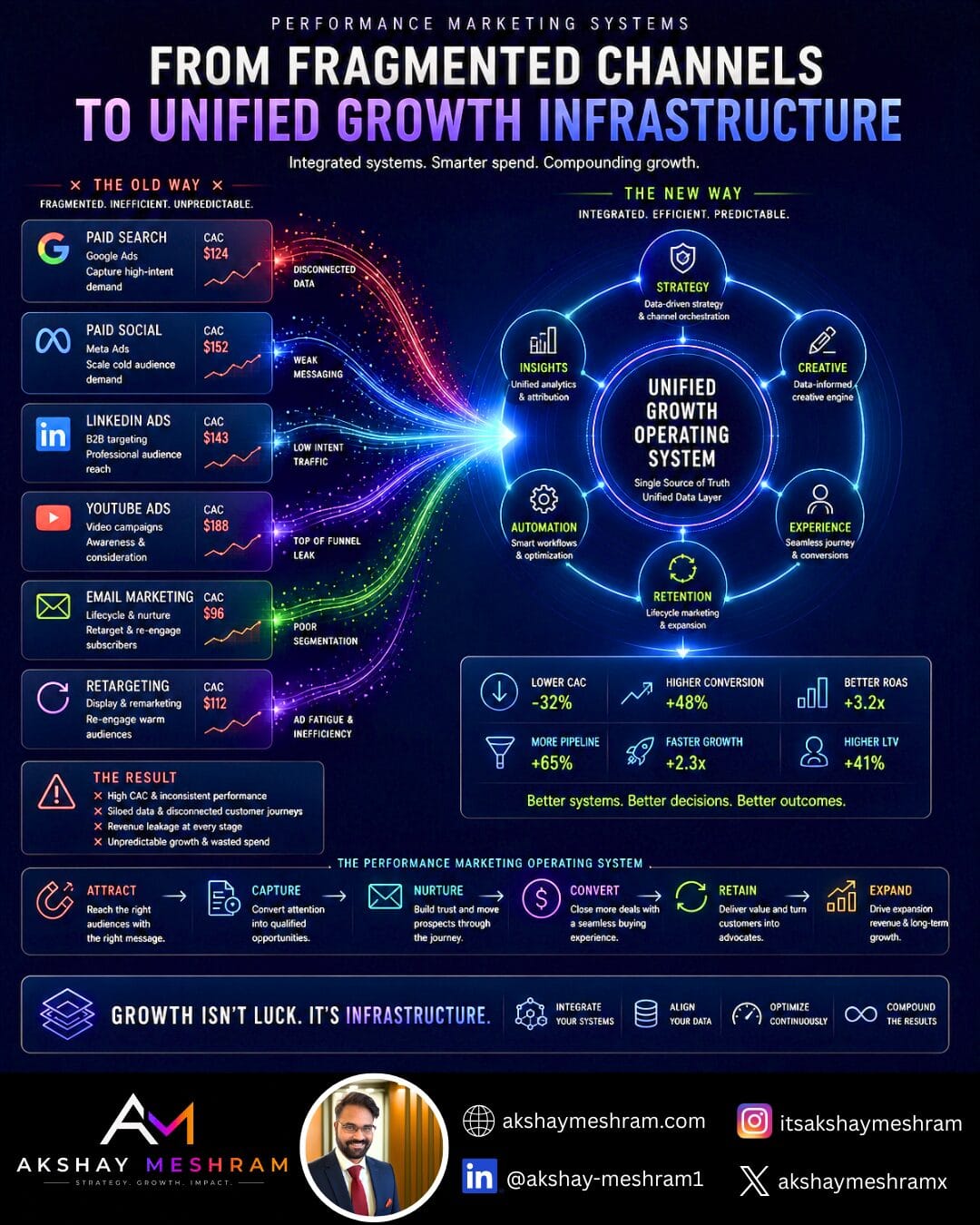
Many SaaS funnels look sophisticated from the outside.
There are:
- paid campaigns
- webinars
- SEO traffic
- onboarding flows
- retargeting systems
- CRM automation
- sales sequences
- customer education assets
Yet underneath the surface, the customer journey often feels fragmented.
The messaging changes between stages.
The positioning shifts.
The promises evolve.
The intent alignment weakens.
What begins as a high-intent educational experience frequently turns into an aggressive conversion environment.
Trust deteriorates.
Modern buyers notice this immediately.
Especially in SaaS.
Today’s buyers consume:
- product reviews
- founder content
- comparison pages
- LinkedIn commentary
- customer testimonials
- YouTube breakdowns
- community discussions
- educational content
long before submitting a demo request.
This means trust accumulation now happens across a distributed information ecosystem.
Not a linear funnel.
The companies that understand this build systems around continuity.
Not isolated campaigns.
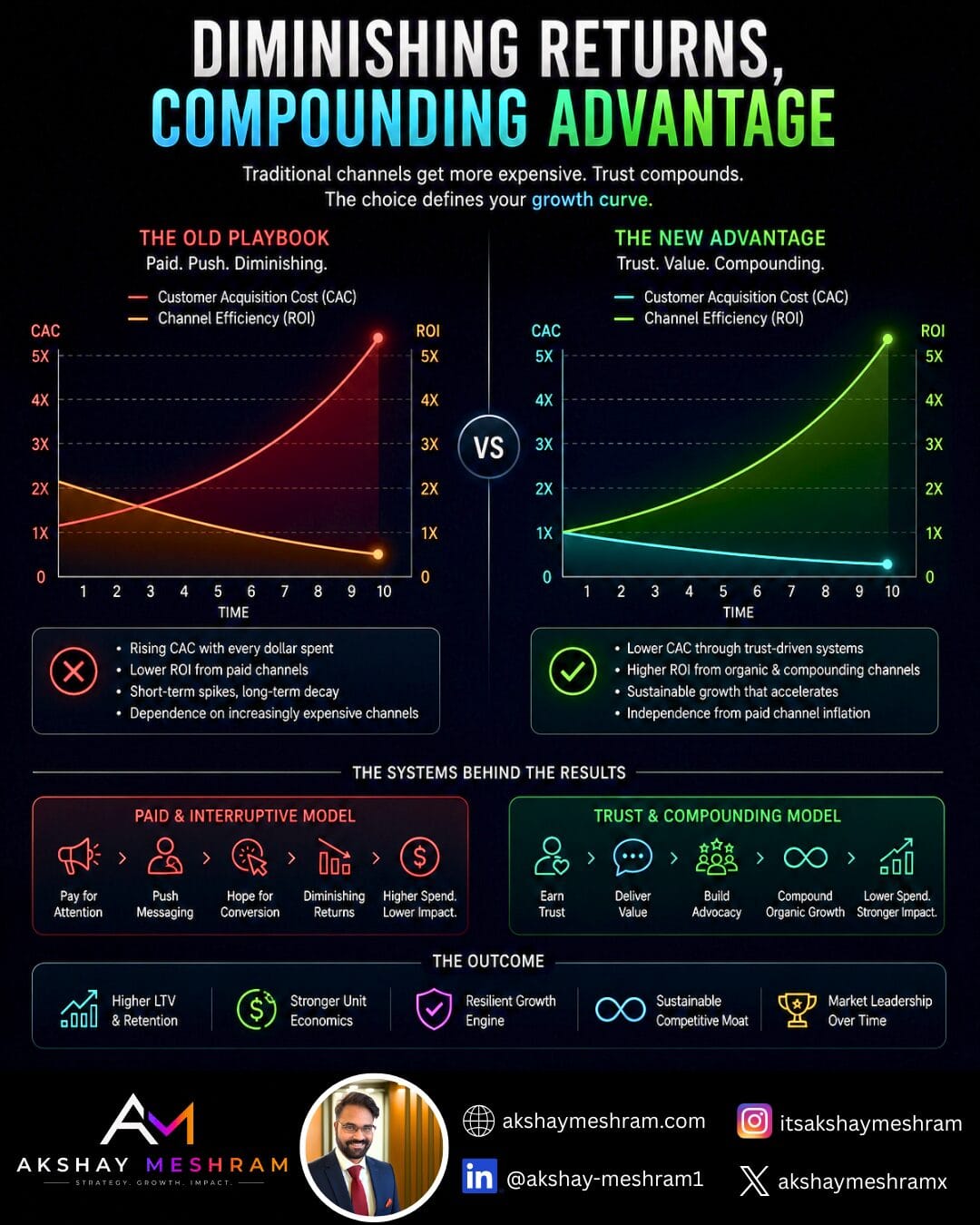
Why Channel Optimization Alone Eventually Hits Diminishing Returns
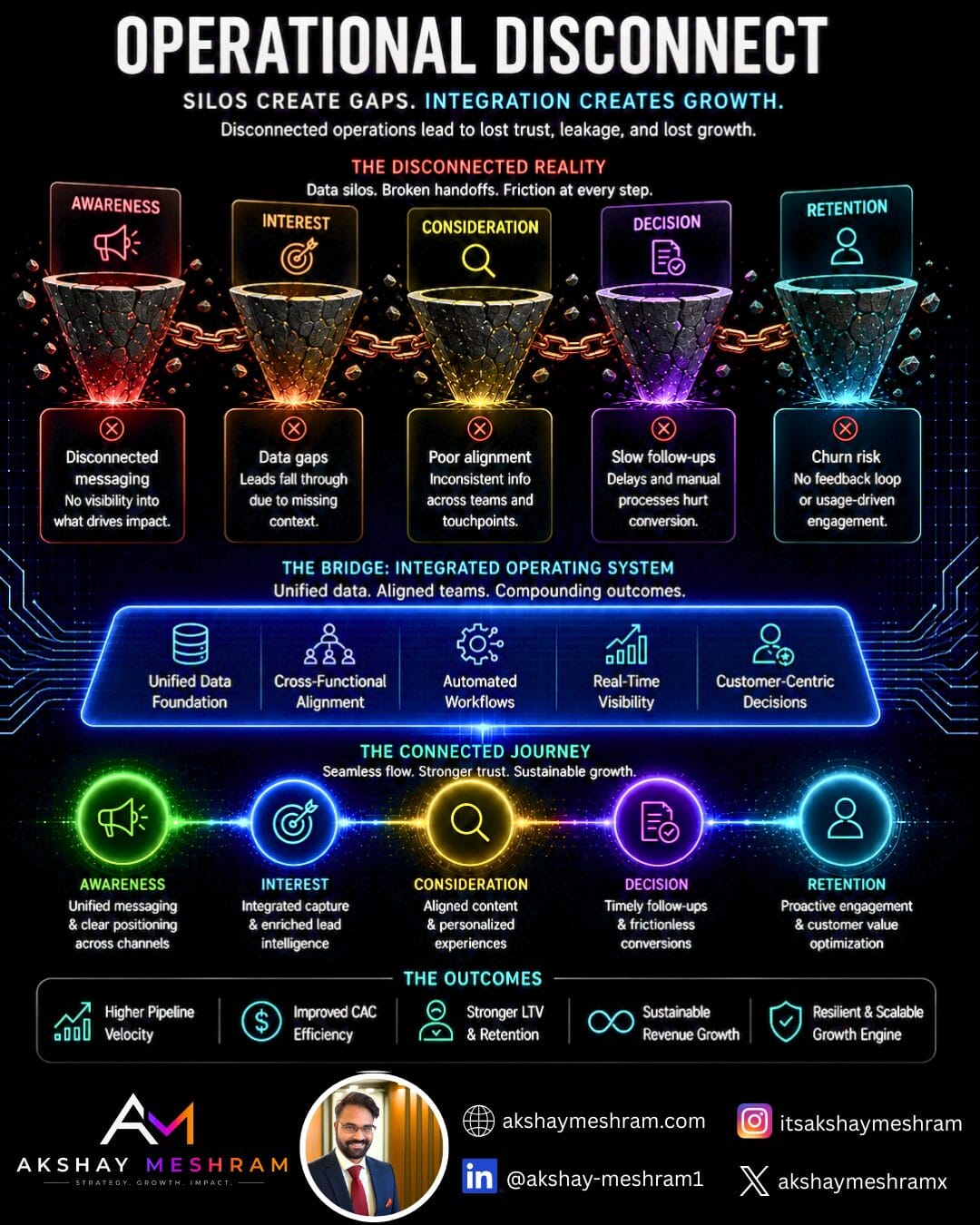
Most acquisition channels eventually saturate.
That is not a platform problem.
It is an economic reality.
As markets mature:
- competition increases
- audience attention fragments
- CPCs rise
- buyers become more skeptical
- creative fatigue accelerates
- conversion volatility increases
At early stages, tactical optimization can still produce meaningful gains.
But over time, the companies that continue scaling efficiently usually shift their focus away from isolated channel metrics and toward system-wide efficiency.
Search visibility increasingly depends on long-term trust, content quality, and topical authority.
That means thinking about:
- brand familiarity
- trust acceleration
- category authority
- intent sequencing
- audience education
- conversion continuity
- retention economics
Sophisticated operators understand something many growth teams underestimate:
The strongest acquisition systems reduce resistance before the buyer enters the funnel.
That changes the economics entirely.
Because warm demand consistently outperforms forced demand.
Full-Funnel Growth Systems Are Really Trust Distribution Systems
Funnels are often explained mechanically.
Traffic enters.
Leads progress.
Conversions happen.
Revenue grows.
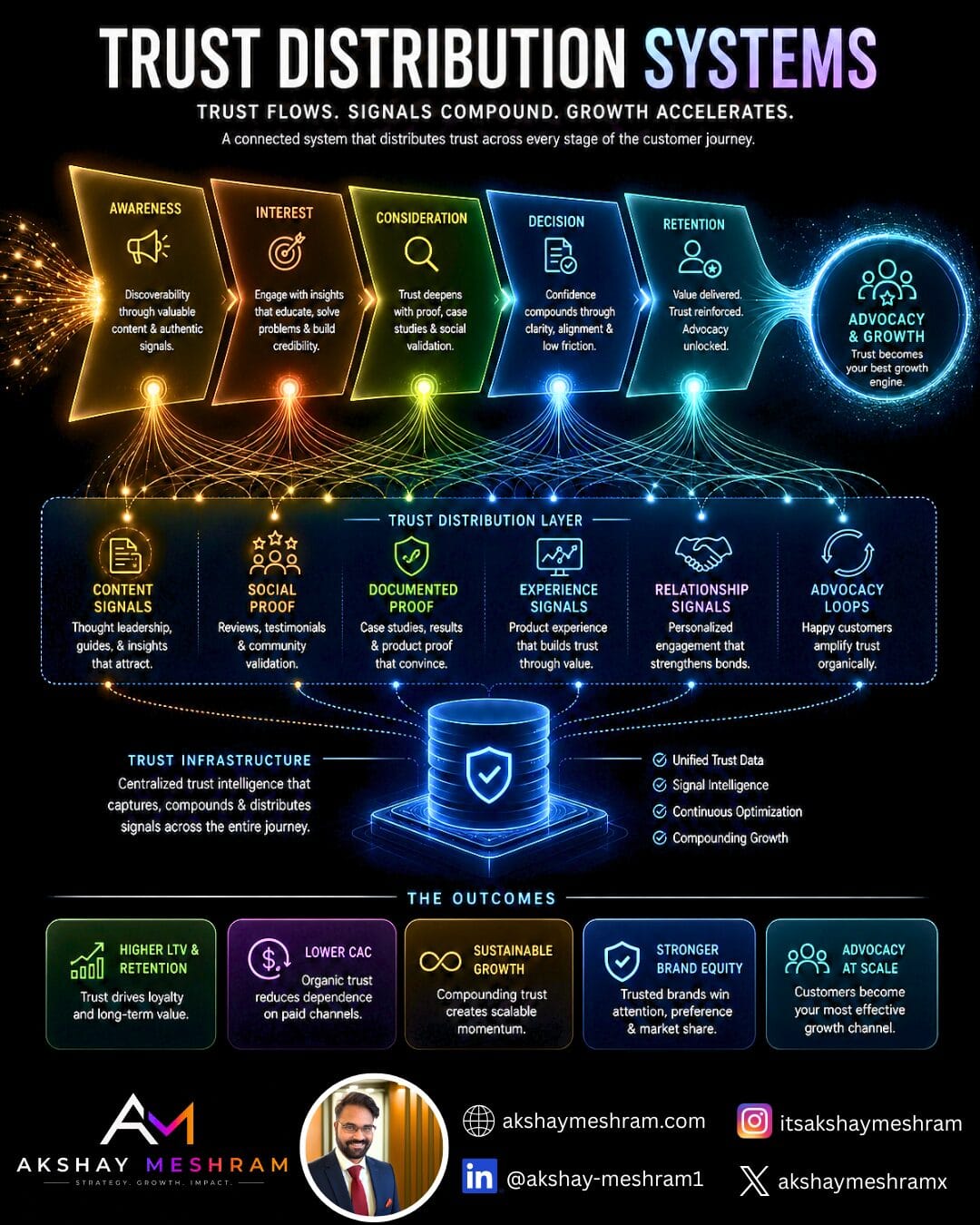
In reality, modern SaaS funnels behave far more like trust distribution systems.
Every interaction either:
- compounds trust
- maintains trust
- or weakens trust
The strongest SaaS growth systems compound trust across every customer interaction.
That includes:
- content quality
- positioning clarity
- onboarding experience
- product education
- sales conversations
- landing page messaging
- customer proof
- thought leadership
- product UX
This is why full-funnel growth is increasingly inseparable from brand.
Not brand in the traditional sense of logos or campaigns.
Brand as accumulated market confidence.
Sophisticated SaaS companies understand that performance marketing performs better when trust already exists.
That dramatically changes how acquisition should be designed.
Awareness Is No Longer About Reach Alone
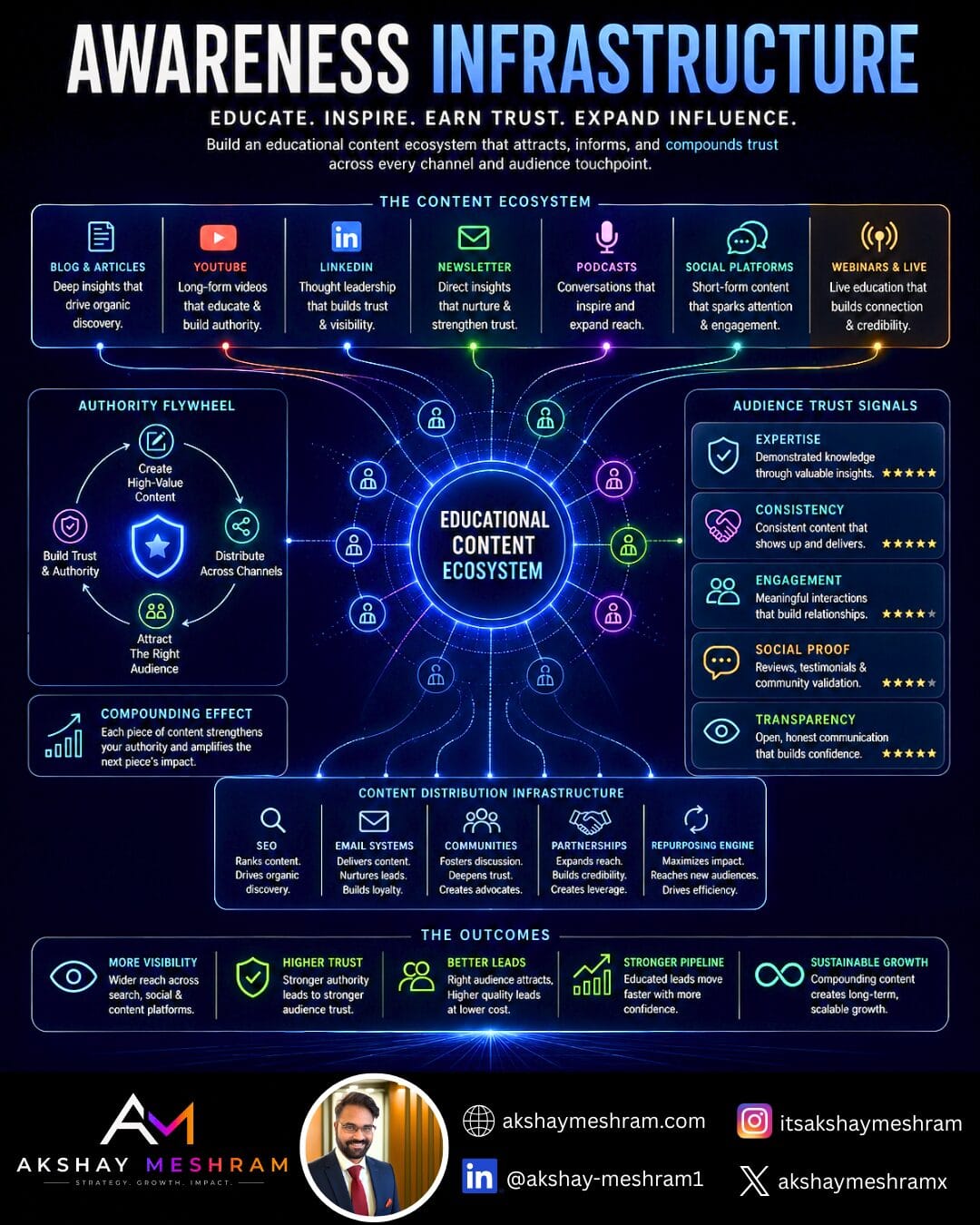
Modern awareness campaigns are not simply attention-generation mechanisms.
They are expectation-setting systems.
The strongest SaaS companies use awareness content to:
- educate markets
- frame problems intelligently
- shape category narratives
- establish strategic credibility
- reduce future conversion resistance
This is one reason companies like:
- HubSpot
- Ahrefs
- Notion
- Shopify
invest heavily in educational ecosystems.
Their content is not merely designed to generate traffic.
It is designed to:
- reduce market uncertainty
- build trust before conversion
- establish category association
- create authority asymmetry
That compounds over time.
Consideration Is Where Most Funnels Quietly Collapse
Many SaaS companies focus heavily on:
- acquisition
- lead generation
- campaign metrics
while underinvesting in the mid-funnel experience.
That creates a hidden problem.
Buyers become interested.
But they do not become convinced.
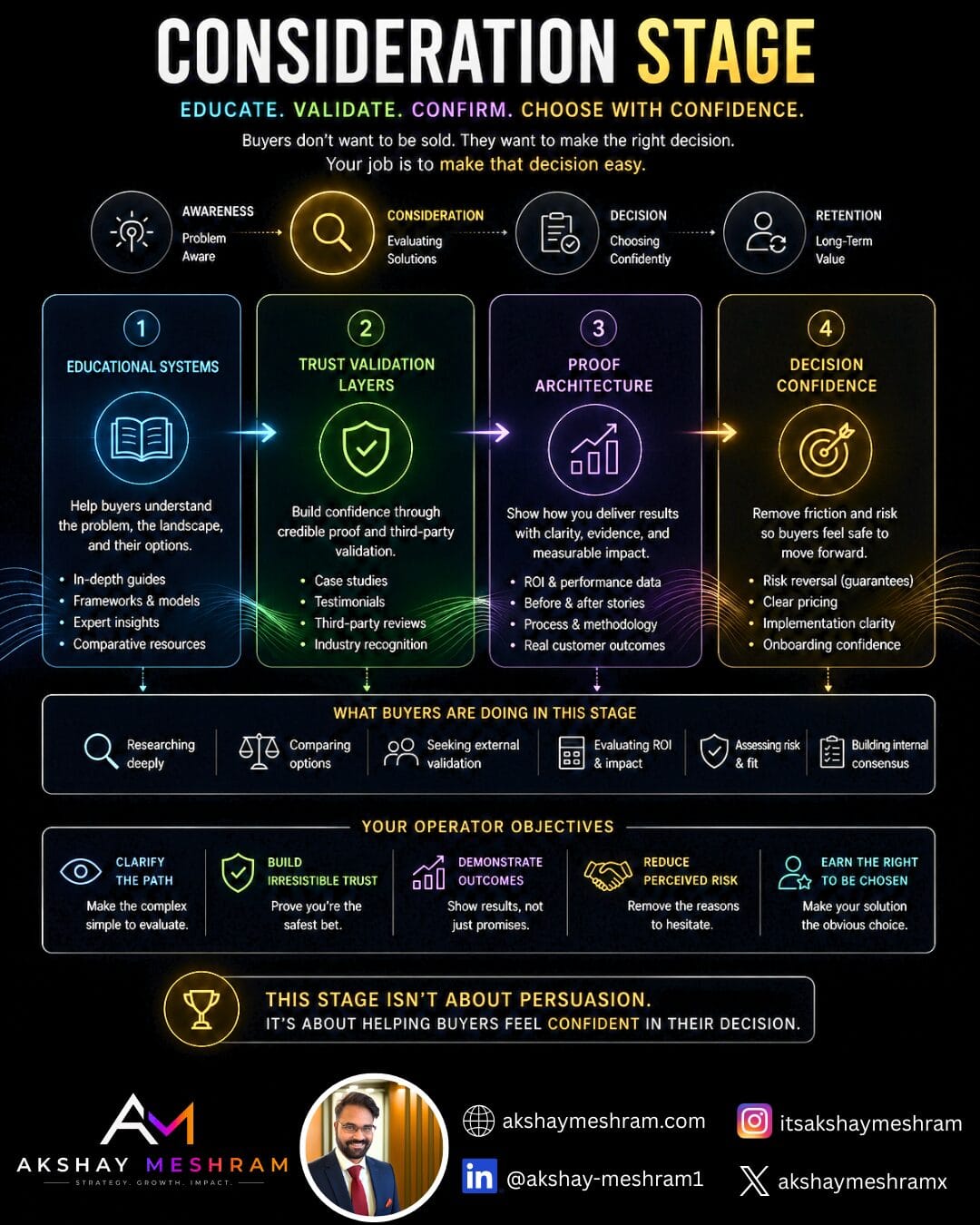
The consideration stage is where:
- trust either compounds
- or hesitation accumulates
This is why sophisticated operators obsess over:
- educational sequencing
- proof architecture
- objection reduction
- positioning clarity
- onboarding continuity
- customer evidence
The strongest funnels rarely feel aggressively optimized.
They feel coherent.
That difference matters psychologically.
Because buyers increasingly evaluate companies through accumulated micro-signals.
Not isolated landing pages.
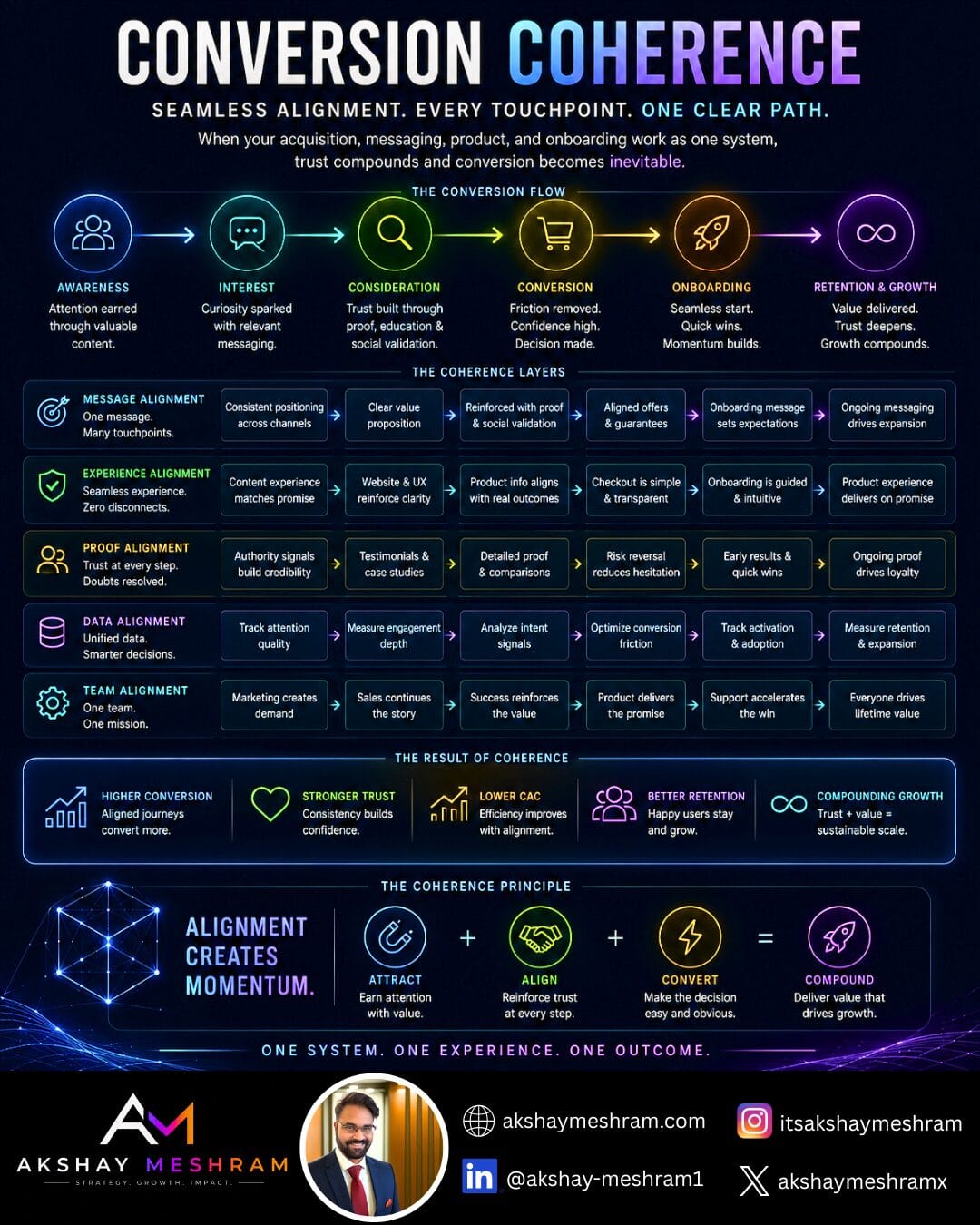
Conversion Is an Outcome of System Coherence
Conversion optimization discussions often become excessively tactical.
Button colors.
Headline testing.
CTA placement.
Micro-copy.
Those details matter.
But sophisticated conversion systems are usually driven more by coherence than isolated optimizations.
The strongest SaaS funnels maintain continuity across:
- acquisition messaging
- educational content
- landing page positioning
- onboarding expectations
- sales communication
- customer experience
When continuity breaks, friction increases.
And friction is rarely visible immediately.
It appears indirectly through:
- lower demo-to-close rates
- slower sales cycles
- weak onboarding activation
- retention instability
- rising CAC pressure
The companies that scale sustainably reduce contextual friction before aggressively optimizing conversion mechanics.
That sequencing is strategically important.
The Four Layers of Modern SaaS Growth Systems
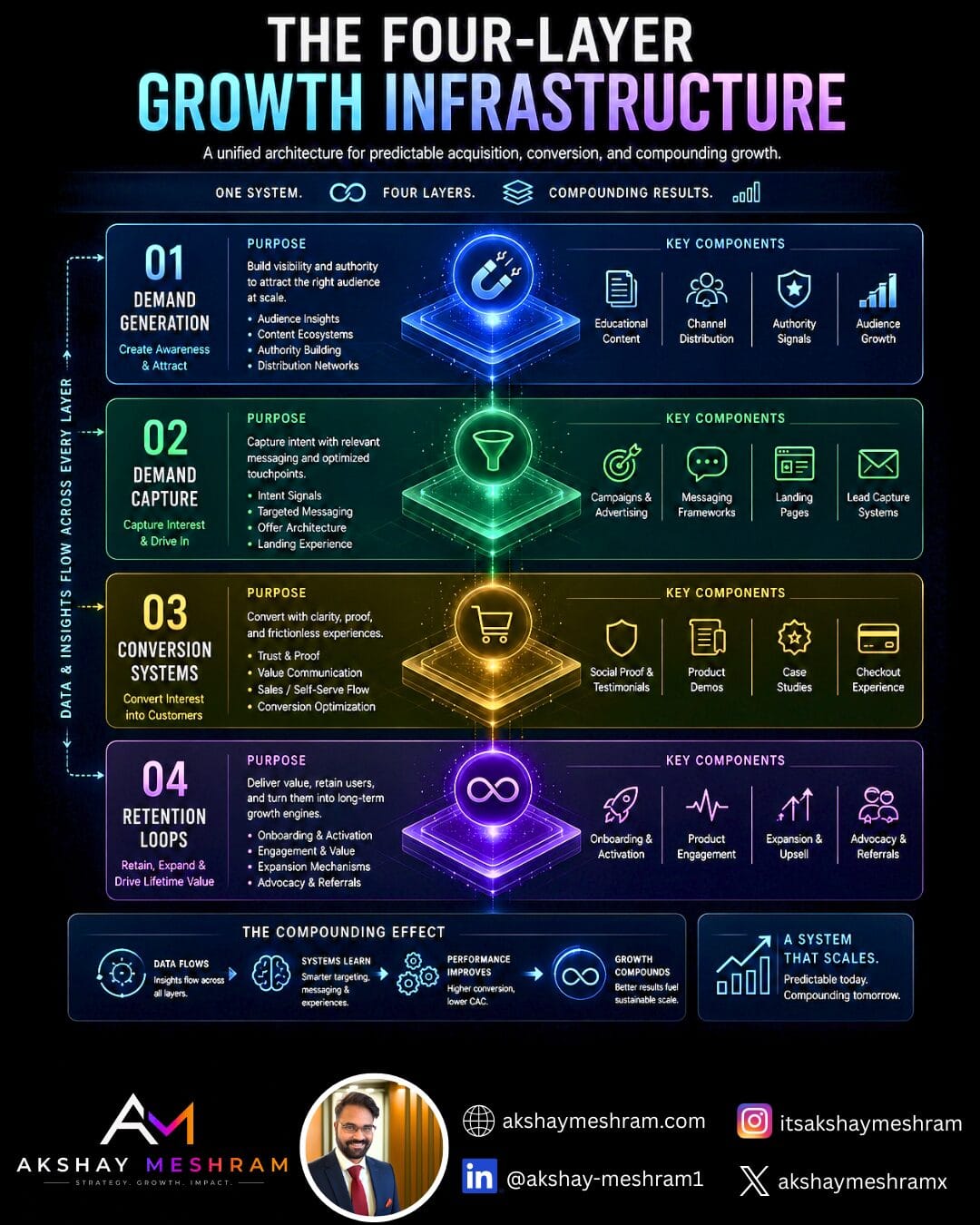
Modern SaaS growth systems are rarely built around a single acquisition channel.
They are built around layered infrastructure.
That distinction matters because sustainable growth usually emerges from the interaction between systems – not isolated tactics.
Sophisticated SaaS companies typically operate across four interconnected layers.
Sophisticated operators increasingly think in terms of integrated growth systems rather than isolated campaign tactics.
Layer 1: Demand Creation Infrastructure
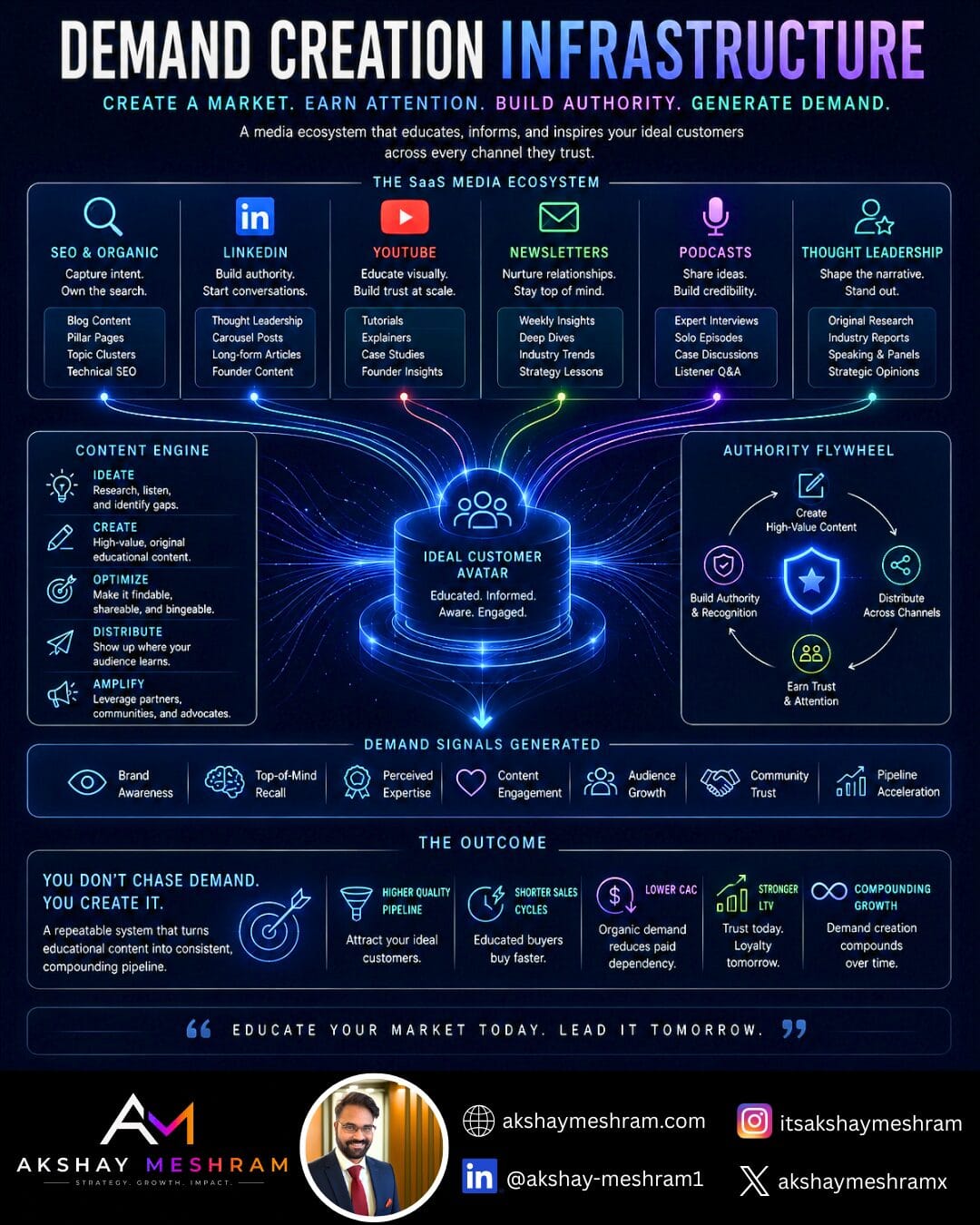
Demand creation is where long-term growth advantages usually begin.
Unfortunately, many SaaS companies underinvest here because demand creation often compounds slowly.
It does not always produce immediate attribution clarity.
But sophisticated operators understand something critically important:
The companies that create market understanding before buyers enter active purchase intent frequently reduce future acquisition costs substantially.
Demand creation infrastructure includes:
- educational SEO ecosystems
- founder-led content
- category education
- thought leadership
- strategic media distribution
- audience trust systems
- newsletter ecosystems
- YouTube education
- LinkedIn authority content
This is one reason modern SaaS companies increasingly behave like media organizations.
Not because content is trendy.
Because trust compounds economically.
Companies like:
- HubSpot
- Ahrefs
- Shopify
built substantial demand-generation advantages through educational ecosystems long before many competitors understood the strategic implications.
Layer 2: Demand Capture Infrastructure
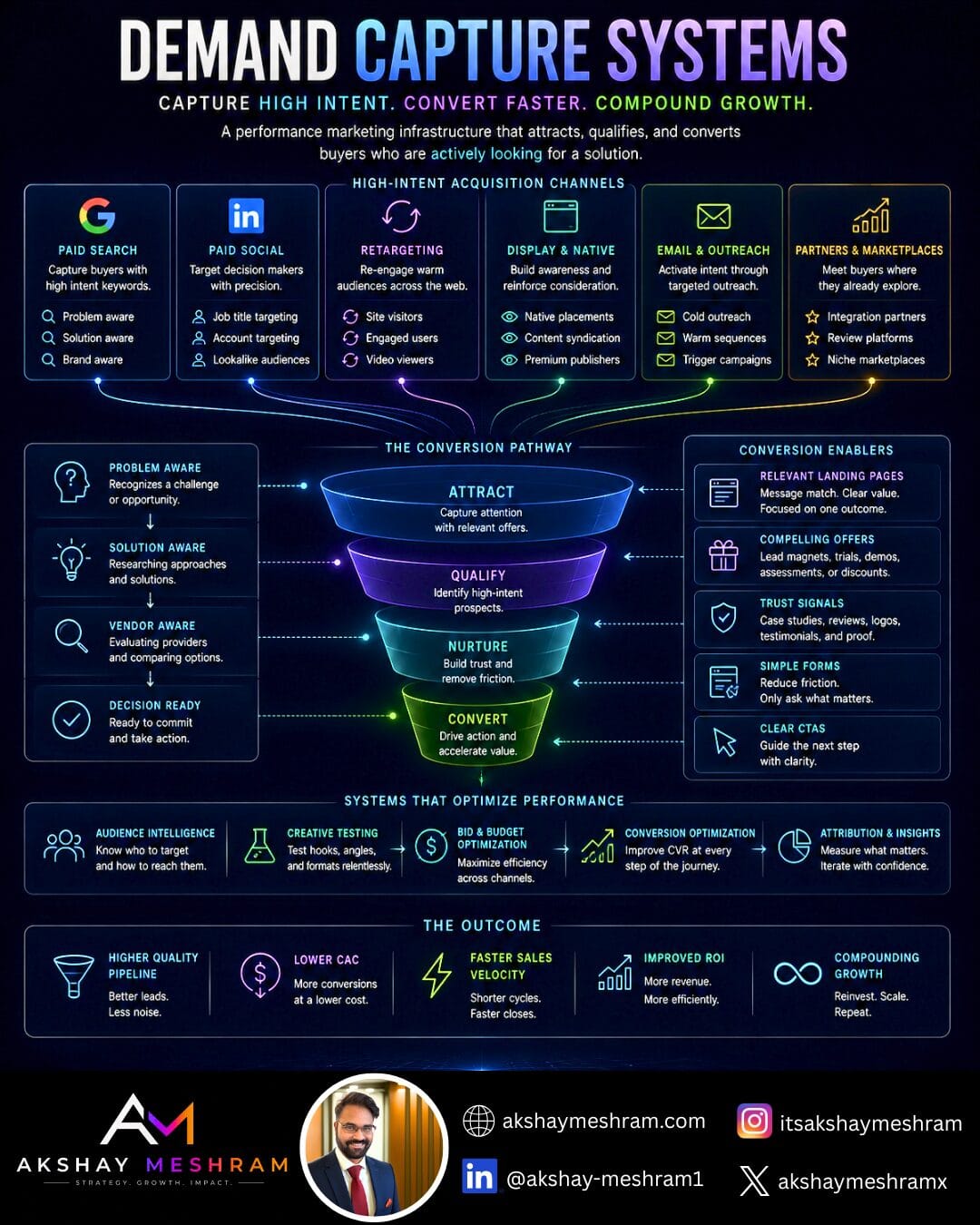
Demand capture converts existing intent.
This includes:
- paid search
- retargeting
- high-intent landing pages
- comparison pages
- branded search
- demo funnels
- conversion-focused acquisition systems
Demand capture matters.
High-performing SaaS companies balance demand generation systems with demand capture infrastructure to improve long-term acquisition efficiency.
But many SaaS companies overinvest in capture before sufficient market demand exists.
That creates dangerous acquisition economics.
Because conversion efficiency weakens when:
- trust familiarity is low
- category understanding is weak
- audience education is insufficient
- brand recognition is limited
Sophisticated operators usually balance:
- demand creation
with: - demand capture
instead of relying exclusively on bottom-funnel conversion mechanics.
This distinction becomes increasingly important as CAC rises across competitive SaaS markets.
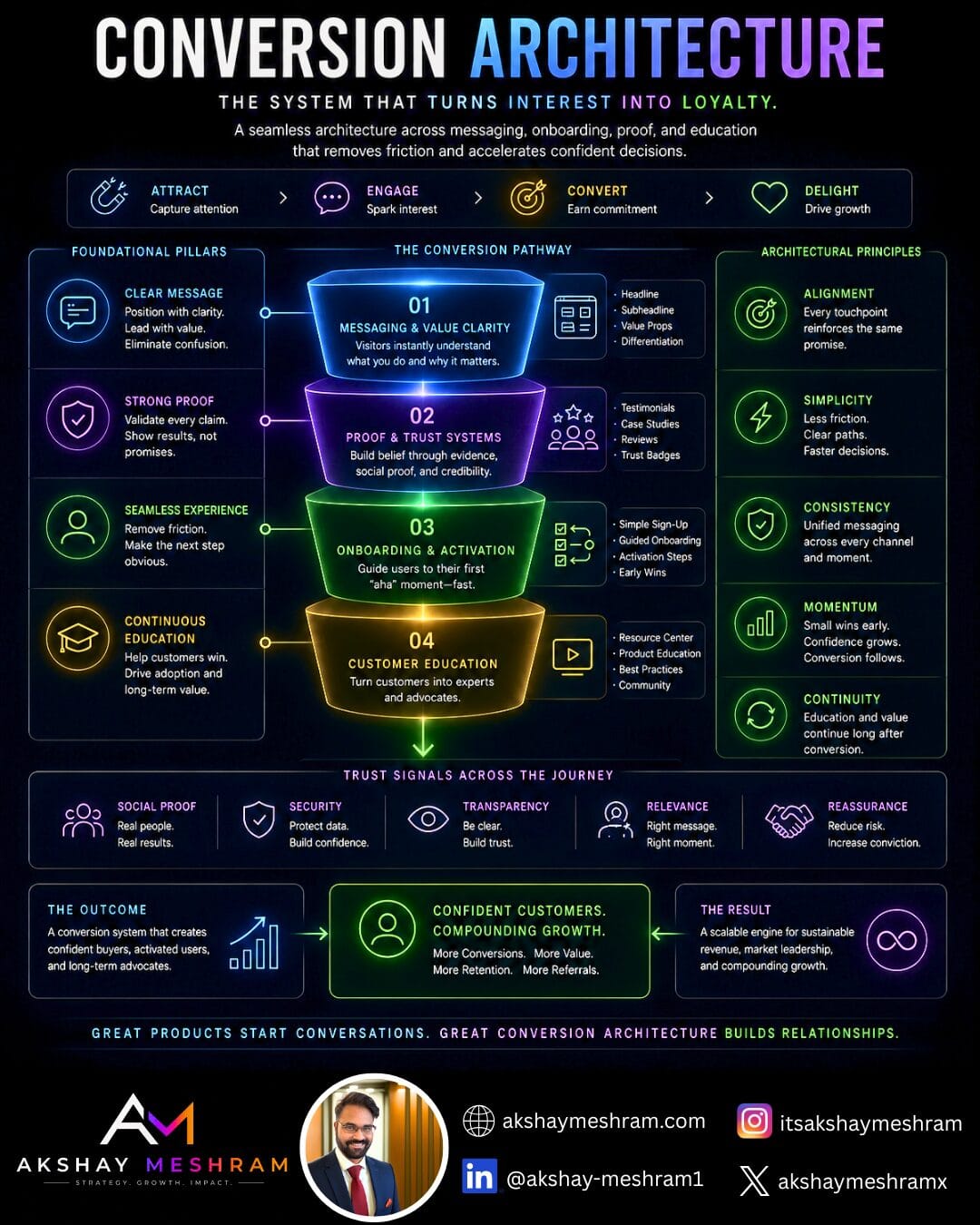
Layer 3: Conversion Architecture
Most conversion discussions focus too heavily on surface-level optimization.
But sophisticated conversion systems are usually built around friction reduction.
Not persuasion pressure.
High-performing SaaS companies reduce:
- uncertainty
- onboarding confusion
- positioning ambiguity
- trust friction
- context switching
- decision fatigue
This is why:
- onboarding experience
- proof architecture
- messaging continuity
- product education
- customer evidence
matter so heavily in modern SaaS growth systems.
The strongest funnels often feel intuitive because the customer journey has been carefully aligned operationally.
Not merely optimized cosmetically.
Why Funnel Friction Usually Comes From Context Loss
One of the most underestimated conversion problems in SaaS is context fragmentation.
A buyer clicks an ad expecting one thing.
The landing page communicates another.
The onboarding experience shifts positioning again.
The sales conversation reframes value differently.
Each disconnect increases cognitive resistance.
Sophisticated operators reduce these gaps aggressively.
Because consistency compounds trust.
Layer 4: Retention and Expansion Loops
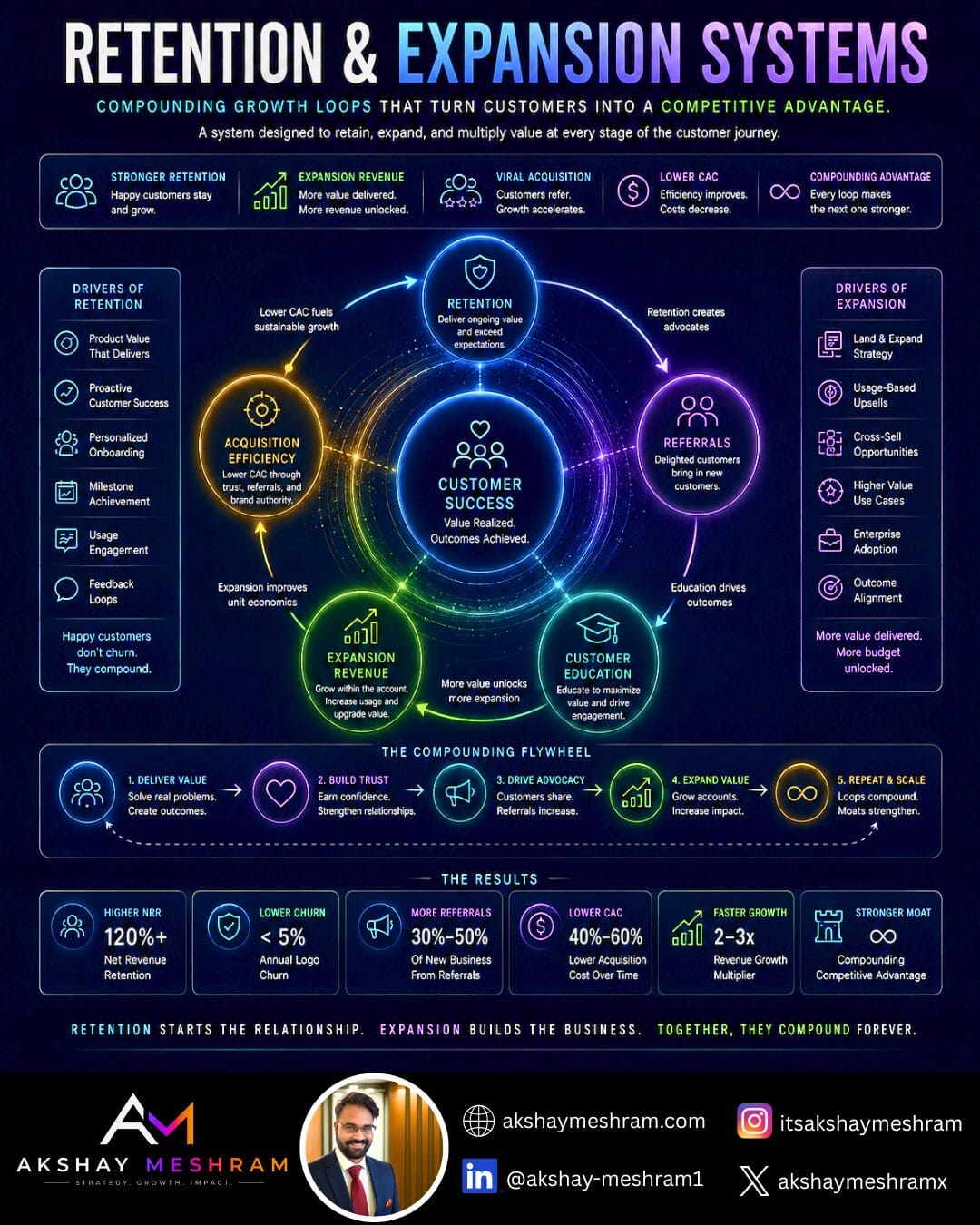
Many companies treat retention as a post-growth function.
Sophisticated SaaS operators treat retention as acquisition economics infrastructure.
Because retention directly influences:
- CAC efficiency
- LTV expansion
- referral generation
- expansion revenue
- payback periods
- sustainable scaling capacity
This is why modern growth systems increasingly integrate:
- customer success
- lifecycle marketing
- product education
- expansion systems
- community infrastructure
into growth strategy itself.
The strongest SaaS businesses improve acquisition efficiency partly because retention compounds future growth.
That creates structural advantages competitors struggle to replicate quickly.
Why Sophisticated SaaS Companies Obsess Over Funnel Economics – Not Vanity Metrics
Vanity metrics often create false confidence.
Traffic spikes.
Lead volume increases.
CTR improves.
ROAS temporarily rises.
Yet none of those metrics automatically indicate durable growth quality.
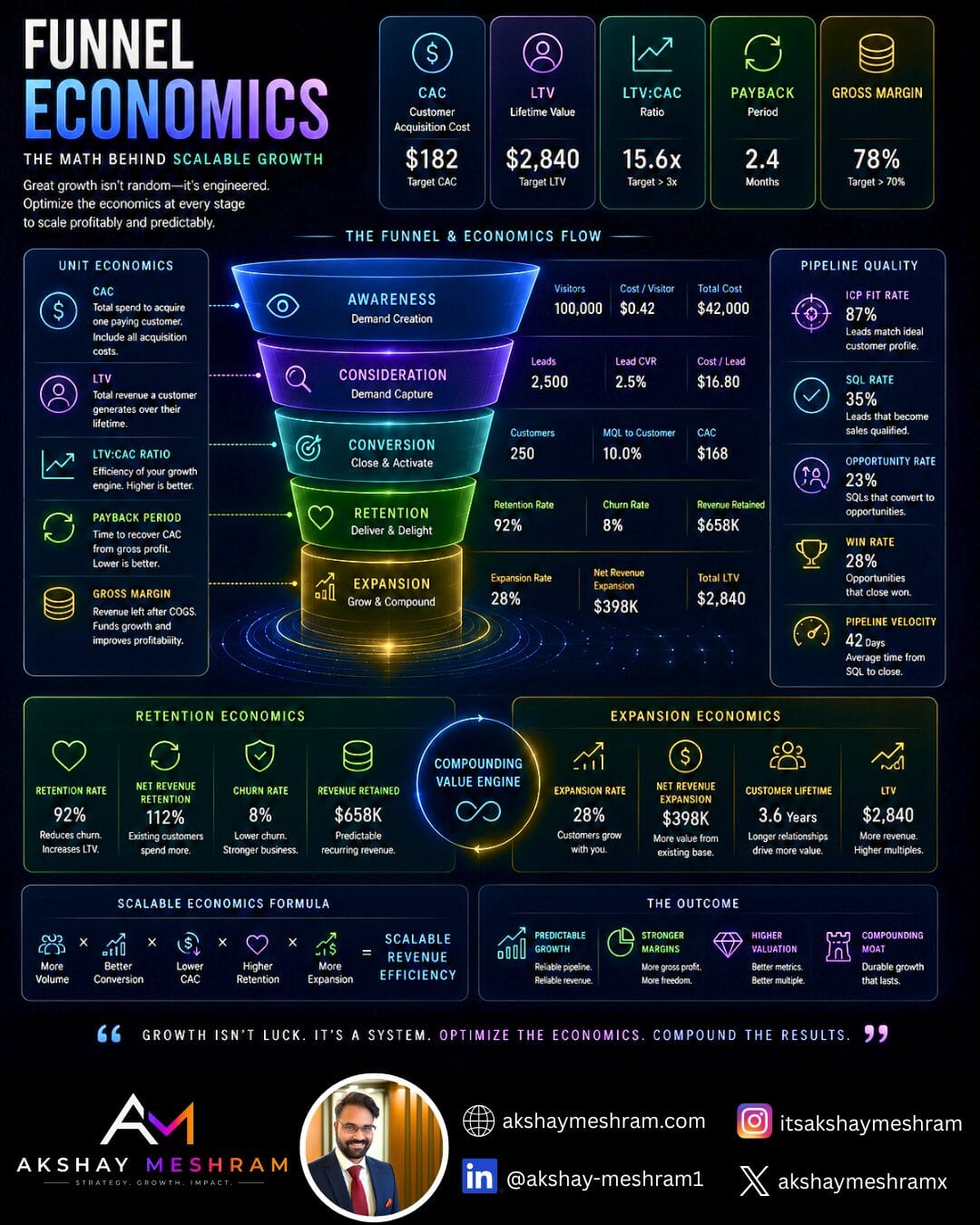
Sophisticated operators increasingly focus on:
- CAC payback
- retention-adjusted acquisition economics
- revenue quality
- expansion potential
- pipeline velocity
- conversion efficiency over time
because growth quality matters more than isolated campaign performance.
High-performing SaaS growth systems rely on alignment between positioning, demand generation, conversion, and retention.
ROAS Alone Is a Misleading Growth Metric
ROAS can be directionally useful.
But many SaaS companies over-rely on it.
This creates distorted decision-making because short-term ROAS frequently favors:
- demand harvesting
- branded search
- warm audiences
- low-funnel conversion activity
while under-valuing:
- category education
- trust building
- thought leadership
- awareness creation
- long-term demand generation
Sophisticated operators evaluate acquisition systems through broader economic lenses.
Because scalable growth is rarely built exclusively through last-click efficiency.
CAC Payback Often Matters More Than Cost Per Lead
Lead quality matters far more than lead quantity.
Many companies generate large lead volumes that:
- convert poorly
- churn quickly
- expand weakly
- create operational inefficiency
Sophisticated SaaS growth systems optimize for:
- revenue efficiency
- pipeline quality
- retention probability
- expansion economics
That usually creates stronger long-term acquisition sustainability.
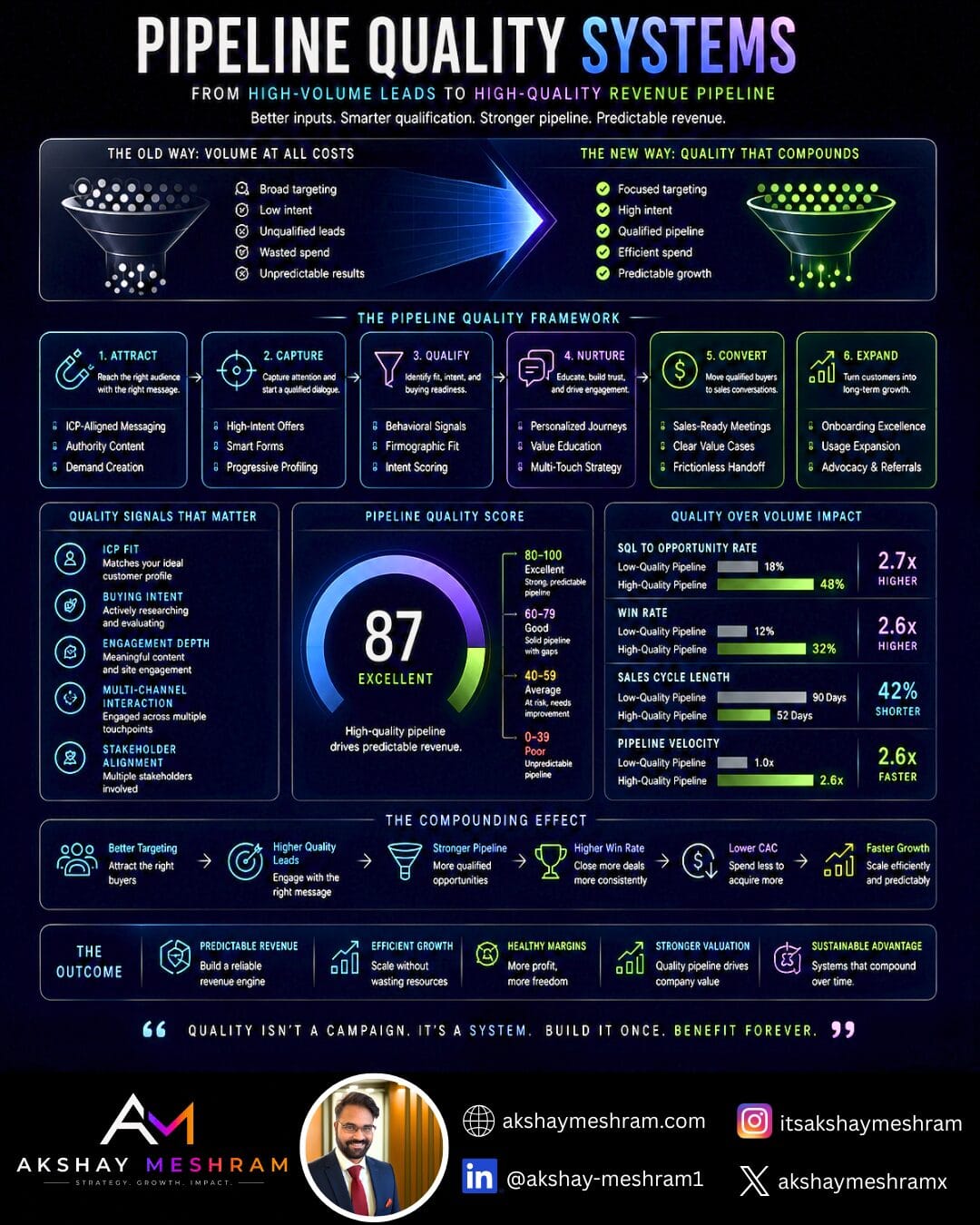
Pipeline Quality Eventually Becomes More Important Than Lead Volume
As companies scale, acquisition complexity increases.
The challenge shifts from:
- generating leads
to:
- generating commercially aligned pipeline.
This is why mature operators increasingly prioritize:
- ICP precision
- qualification accuracy
- sales alignment
- intent scoring
- buyer readiness
because pipeline quality compounds operational efficiency.
Why Many SaaS Companies Fail to Build Sustainable Growth Systems
Most growth systems do not fail because teams lack effort.
They fail because acquisition becomes fragmented.
They Optimize Channels Instead of Customer Journeys
Many organizations structure growth around channel ownership instead of buyer progression.
That creates:
- messaging fragmentation
- attribution conflict
- inconsistent positioning
- operational silos
Sophisticated operators design systems around customer movement.
Not departmental structure.
They Scale Spend Before Fixing Funnel Friction
Increasing budget does not fix structural inefficiency.
In many cases, scaling inefficient funnels simply accelerates wasted spend.
Sophisticated companies usually:
- stabilize conversion continuity
- improve onboarding clarity
- strengthen positioning
- reduce trust friction
before aggressively scaling acquisition investment.
They Treat Demand Generation and Demand Capture as Separate Functions
Modern SaaS growth increasingly depends on coordination.
Demand generation influences:
- branded search
- retargeting efficiency
- conversion quality
- pipeline readiness
These systems influence each other constantly.
The strongest operators build integrated acquisition ecosystems.
They Underestimate the Role of Trust Accumulation
Trust compounds silently.
Buyers rarely convert because of one interaction.
They convert because:
- familiarity increases
- uncertainty decreases
- authority compounds
- positioning becomes clearer
Sophisticated SaaS growth systems are designed around this psychological reality.
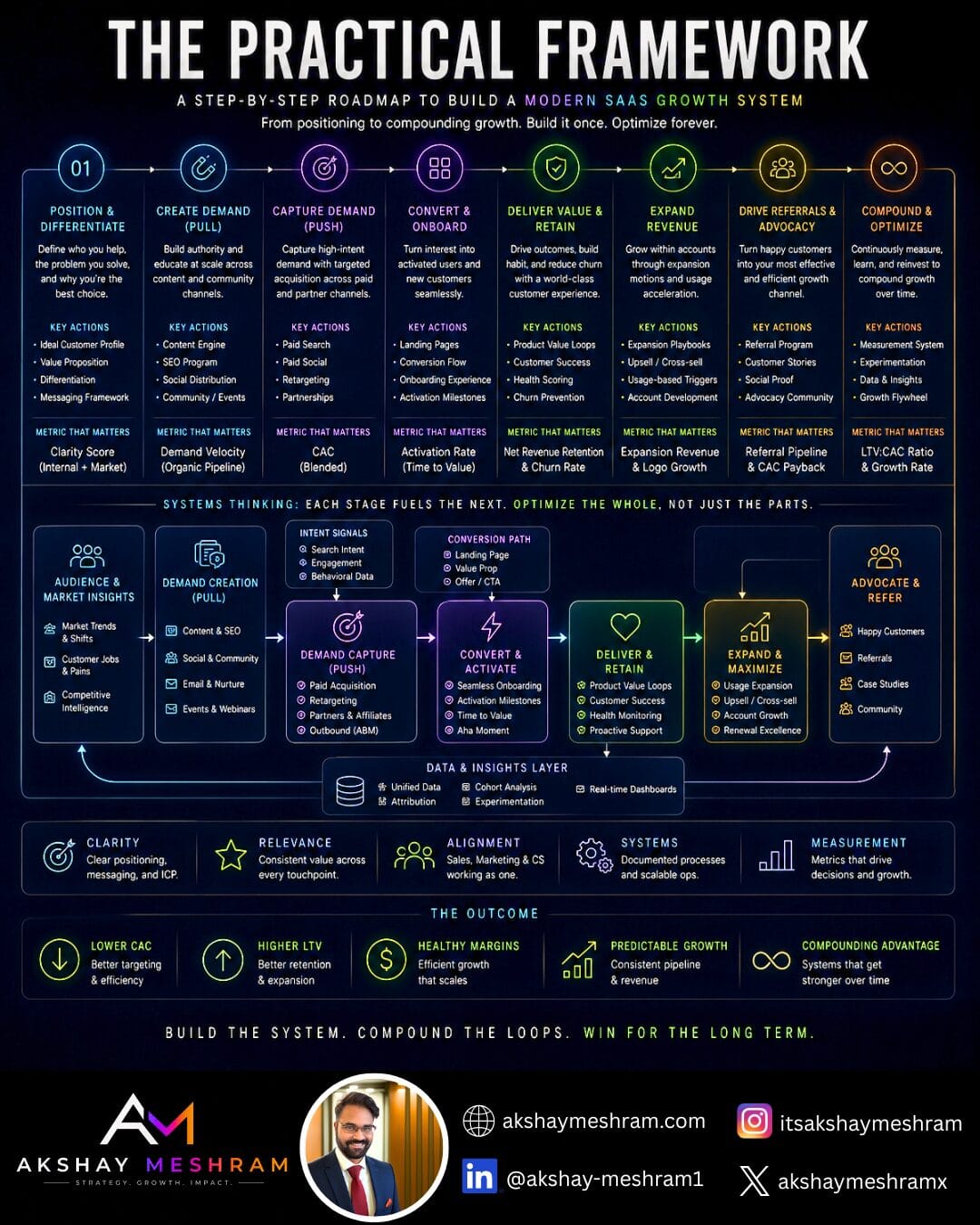
A Practical Framework for Building a Full-Funnel SaaS Growth System
Building sophisticated growth infrastructure requires sequencing.
Modern SaaS companies increasingly invest in scalable go-to-market infrastructure before aggressively expanding acquisition spend.
Not random tactic accumulation.
Phase 1: Establish Category and Audience Clarity
Before scaling acquisition:
- define the market problem clearly
- identify ICP sophistication
- clarify positioning
- understand buying psychology
- map trust barriers
Many growth problems are actually positioning problems.
Phase 2: Build Demand Generation Assets
Create educational infrastructure that compounds:
- SEO content
- founder-led insights
- thought leadership
- newsletters
- webinars
- audience education systems
Demand generation usually compounds slower.
But its long-term economic advantages are substantial.
Sophisticated SaaS growth systems increasingly rely on integrated demand creation ecosystems rather than isolated campaign execution. This is why modern operators invest heavily in scalable demand generation infrastructure.
Phase 3: Strengthen Intent Capture Infrastructure
Once awareness systems mature:
- improve landing pages
- strengthen retargeting
- optimize search intent capture
- align conversion messaging
- improve funnel continuity
This increases conversion efficiency.
Phase 4: Improve Conversion Continuity Across the Funnel
Ensure messaging consistency across:
- ads
- content
- onboarding
- sales conversations
- lifecycle communication
Continuity reduces friction.
Phase 5: Build Feedback Loops Between Acquisition, Sales, and Retention
Sophisticated operators create:
- attribution learning loops
- customer insight loops
- retention feedback systems
- sales intelligence sharing
because growth systems improve when information flows continuously across teams.
Final Strategic Takeaway
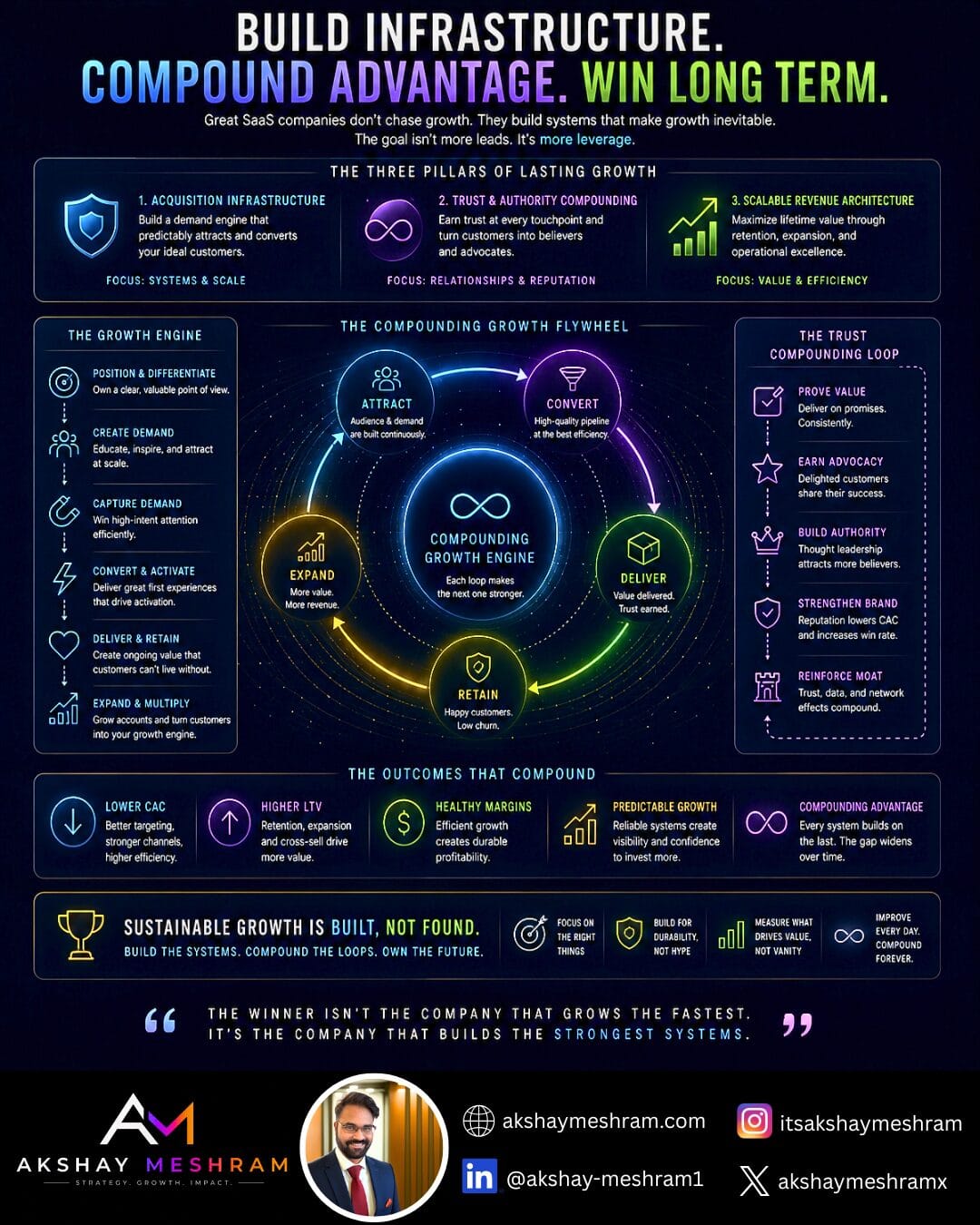
Modern SaaS growth systems are increasingly built around interconnected acquisition infrastructure rather than isolated campaigns. The future of performance marketing belongs to companies that understand growth as infrastructure.
Not campaigns.
The strongest SaaS companies increasingly behave less like advertisers and more like system architects.
They build:
- trust before demand peaks
- educational ecosystems before scaling spend
- audience familiarity before conversion pressure
- retention systems before aggressive acquisition
This creates compounding advantages.
Because growth efficiency rarely comes from isolated channel optimization forever.
It usually emerges from:
- strategic coherence
- audience trust
- operational alignment
- distribution consistency
- acquisition infrastructure
Performance marketing is evolving.
The companies that continue treating it purely as ad optimization will likely face increasing acquisition inefficiency over time.
The companies that understand it as a full-funnel growth system will build far more durable advantages.
And in modern SaaS markets, durable growth systems matter more than temporary spikes.
FAQ Section
What is a full-funnel growth system?
A full-funnel growth system is an integrated acquisition framework that aligns awareness, consideration, conversion, retention, and expansion into a cohesive growth infrastructure designed to compound trust and revenue efficiency over time.
Why do many SaaS funnels fail to scale?
Many SaaS funnels fail because they optimize isolated channels instead of building coherent acquisition systems. Rising CAC, fragmented messaging, weak trust continuity, and poor conversion alignment often reduce scalability.
What is the difference between demand generation and demand capture?
Demand generation creates market awareness, trust, and buyer intent before purchase consideration. Demand capture converts existing intent through channels like search, retargeting, and conversion-focused acquisition.
Why does trust matter in performance marketing?
Trust reduces buyer resistance. Sophisticated SaaS growth systems improve acquisition efficiency by increasing familiarity, authority, and confidence before conversion decisions occur.
CTA
The companies that compound growth most effectively are rarely the ones chasing isolated acquisition tactics.
They are usually the ones building durable systems around:
- trust
- positioning
- intent alignment
- distribution
- customer understanding
- operational coherence
Modern SaaS growth systems increasingly reward strategic infrastructure over fragmented optimization.
That shift is not temporary.
It is structural.
If you are building long-term authority around SaaS growth, acquisition systems, demand generation, and scalable marketing infrastructure, this is the direction worth understanding deeply.
